



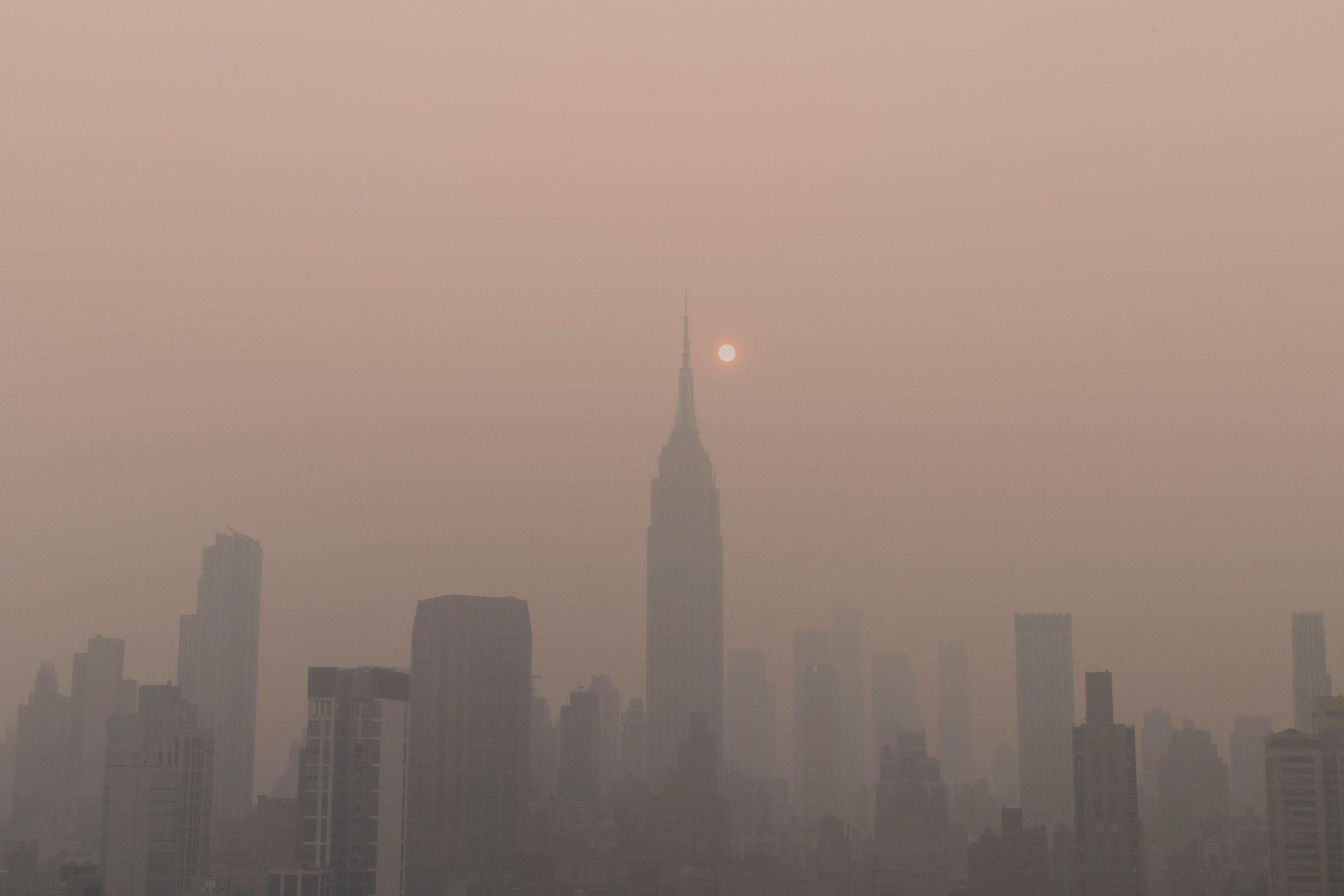
Wildfires raged in Canada this week, shrouding smoke across the Midwestern and Northeastern U.S. Most of us will never see the flames from these fires, but the smoke fills our cities and our lungs.
Chicago closed its beaches and all outdoor pools for the first time since the COVID-19 pandemic. New York’s skyline vanished behind thick haze. And Detroit ranked as having the worst air quality in the world among major cities.
Many people had to evacuate or cancel trips, myself included. And even more have had to watch the air quality reports in their area, figuring out where and how it is safe to breathe—the most automatic, unconscious thing our bodies do.
These fires got me thinking about the poem Wildfire by Joan Kwon Glass. Written in homage to Anne Sexton—the confessional poet who explored the myths through which our culture lives and dies before she died by suicide in 1974.
Grief knows no boundaries
In the poem, wildfire smoke settles over a coastal city on the anniversary of a devastating loss. The poem never says so outright, but between the dedication to Anne Sexton and a young daughter’s question in it about whether the person left a note, the death reads as a suicide.
Reading that detail—a ten-year-old asking whether there was a note—is a reminder that loss rarely stays contained to one person. Like wildfire, it spreads, gets inherited, passed down, remetabolized by the next generation, arriving to each new person in fragments they have to piece together themselves.
The ten-year-old didn’t have any control over her mother’s death, just like we don’t have any control over the hundreds of wildfires burning across North America and the smoke that permeates further than the flames. Wildfire smoke can drift wherever the wind takes it with no regard for lines on a map, and it never rages the exact same way twice. Similarly, grief is not the same for everyone, or even the same way twice for the same person:
Wildfires can cast their smoke across bordersbut you stay dead. My grief stalls at the edges of every map, a hammerdemanding I find new ways to remain a nail. No one can say for sure how long
The poem’s narrator feels stuck in place while everything around her, including something as uncontainable as wildfire smoke, keeps moving. Her grief, she writes, is a hammer—demanding she find new ways to remain a nail. To be that nail is to stay driven down, compliant, hidden, struck again and again, never knowing when or how the next blow will land, only that it will.
Mourning the stages of grief
Wildfires, like grief, can be unpredictable and often catch you off guard. We see this uncertainty bleed into the narrator’s processing of her grief. She notices she’s less angry, and instead of feeling relief, that admission becomes one more thing to mourn:
the forests will burn. I am finally less angry. This feels like something else to mourn.What will fill my lungs?
In grief, an emotion like anger can serve a purpose. It’s proof the love was real. When it fades, what’s left can feel less like healing and more like losing one more piece of the connection.
This poem isn’t telling us how to heal grief, but showing us how porous we actually are—to disasters, other people’s losses, and a kind of shared exposure none of us signed up for.
And I’m sorry if that’s not comforting. We like to imagine our grief as something that can be fixed, healed, or shrink over time. That if you just get through enough anniversaries, the weight lessens, and one day you’ll wake up, and it will be manageable. Your view will no longer be distorted. But in reality, grief stays the same size while life slowly grows bigger around it...
By the end of the poem, the instructions blur together, for wildfires and grief:
Stay inside, they say on the news. Save your breath and imagine coordinatesthat do not exist. Be an obedient nail. Shut the windows tight, and wait.
And to survive the smoke and the loss, the narrator is told to keep doing the one thing grief already demanded of her from the start: stay small, contained, obedient.
Here’s the poem in full:
Wildfire
By Joan Kwon Glass
For three days, yellow haze has enveloped
the coast, bathing this city in unease,coating our narrowing throats. Another year
has passed without you. Today, your daughter,now ten, asked if you left a note.
More questions will come.It is June, and I have never been brave.
Wildfires can cast their smoke across bordersbut you stay dead. My grief stalls
at the edges of every map, a hammerdemanding I find new ways to remain a nail.
No one can say for sure how longthe forests will burn. I am finally less angry.
This feels like something else to mourn.What will fill my lungs?Stay inside, they say on the news.
Save your breath and imagine coordinatesthat do not exist. Be an obedient nail.
Shut the windows tight, and wait.***
I’d love to know: How do you interpret this poem? How have the wildfires or grief affected you this past week?
And Joan Kwon Glass, if you see this, I’d love to hear your inspiration and interpretation of your poem.
— Maura
Thank you Maura for your Sunday morning sharing. I am grateful for this place to process together these feelings- sharing our contemplations...it is so important. Although I am not a disciplined attendant, I am so grateful you have created this space. As for this poem and your take on it...what arises in me, is how much we are conditioned to seek resolution, reprieve, release...but grief and the assured death of everyone we love, including ourselves is not something we can be released from, graduate from, wrap neatly in a package with a bow, "heal or be in remission" from...it is a discomfort we must learn to be with and hopefully stay present with, knowing there will be so many seasons...seasons or just sudden momentsof greater peace - even celebration, but then also ones of greater discomfort and even dread or terror...and no- we have no control over the tides that wash over our hearts...I think most of all, we have eachother...and one who has walked through the valley of grief and is still standing, still able to laugh and bask in the warm rays of sunshine when they appear, is a great comfort on a cloudy day. Today my heart is heavy- not even sure why...I could give many excuses...but I am grateful there is you, on this planet too!