

A creative meditation on impermanence
What Andy Goldsworthy’s temporary art teaches us about letting go


There are only two moments each year when the Sun rises due east and sets due west for everyone on Earth—and one of them just occurred. Friday, March 20th was the spring equinox for those of us in the northern hemisphere, and the autumn equinox for those in the southern hemisphere.
Equinoxes mark a turning point—when seasons shift from winter to spring and from summer to fall—thresholds that have long been celebrated by civilizations across time, from Chichén Itzá to Cahokia. These moments capture the interconnected and cyclical nature of existence—reminding us that endings (death, decay, letting go) are essential to new beginnings (life, growth, transformation), and that each gives meaning to the other, creating a continuous flow. And that life doesn’t move in straight lines, but rather in circles, cycles, and spirals.
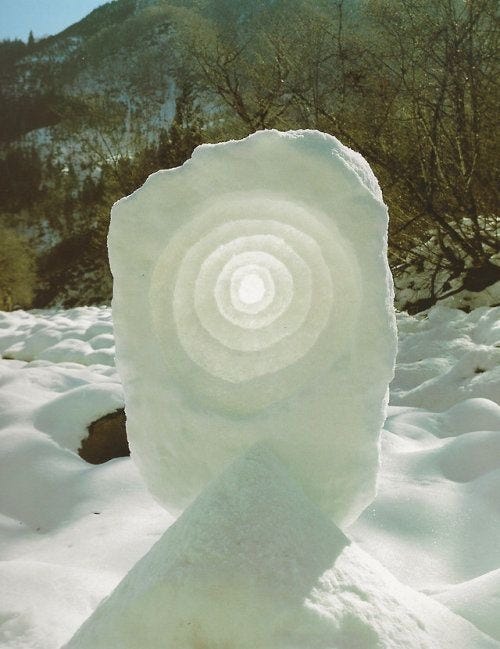
Around this time each year, I find myself thinking about the snow and ice art (as pictured above) created by sculptor and photographer Andy Goldsworthy. His transient artworks consist of concentric circles etched into snow or carved into ice. They’re often already melting as he makes them, an embodiment of impermanence.
When I look at the one pictured above, something in my nervous system settles. It’s like I can almost hear the snow melting and flowing into rivers. I feel the sun warming my skin. To me, the photo evokes a familiar sacredness and childhood nostalgia of a snow day—the kind of natural aliveness we used to know, before modern life and technology made everything so fast, loud, and distracting.
This year, that image feels especially resonant. After the strange, heavy snowstorms that swept through so much of the country, many of us felt winter refuse to let go. Snow in spring is a reminder: the seasons don’t normally flip like a switch, rather they let go gradually, slowly, and on their own timeline.
The sculpture also reminds me that art doesn’t need to last to matter—that nothing does, really. We’ve talked about the concept of symbolic immortality before, and how humans are wired to create things that will outlive us. Goldsworthy’s work is a quiet refusal of that impulse. And, in that refusal, something reveals itself: when we stop making things to last, we start making things to feel.
If you’ve ever seen Goldsworthy’s work, you know everything he makes is already in the process of disappearing. Whether it’s a ring of leaves, a line of stones, or a spiral in the snow, each piece is shaped by hand from the materials he has at hand. Then the artwork is left to the elements to weather, melt, and decay. His art doesn’t try to escape impermanence—it collaborates with it.
“Nature is in a state of change and that change is the key to understanding,” Goldsworthy once said. “I want my art to be sensitive and alert to changes in material, season, and weather. Each work grows, stays, decays. Process and decay are implicit. Transience in my work reflects what I find in nature.”
Most equinox reflections will tell you to set intentions, to plant seeds, to step boldly into the light, and that’s all valuable. But I want to offer another perspective—an invitation to pause at the threshold before rushing forward and springing into action.
Go outside and make something impermanent. Use whatever the season offers you: melting snow, mud, rocks, sticks, dead flowers, or whatever’s near—no need to overthink it. Let the act of making be your meditation. And if the outdoors feels far away or too cold, the same spirit applies at your kitchen table. Impermanent art doesn’t have to be solemn or grand. I recently came across this creative piece of art on Substack, in which someone made a portrait from purple cabbage. Here is the before and after. Same invitation, different materials.
In addition to other practices you might have, such as meditation or exercise, creating temporary art is another way we can practice living well with impermanence.
If you partake in this invitation to create and feel like sharing, I’d love to see what you create.
— Maura
I often think of gardening as art being created, and then changing on its own, and then disappearing waiting to be recreated each year.
Midsummer
I cannot find the photo to share that I'm going to reference here. Let's get that disappointment out of the way...
Years ago, I lived walking distance from work. Two miles thru neighborhoods in a small city in Iowa, but in the middle of the walk was a good sized park. Woodland trails, a creek, hills.
One wintry day, I had just crossed the creek, emerging from the bare trees. And there was an ornament hanging from a limb.
An ice disc with a frozen brown leaf in it. Attached with fishing line, it was obviously not meant to exist forever, if even the week.
That image has never left me, remembering when I stumbled across something that caught my eye and truly stopped my thoughts.